
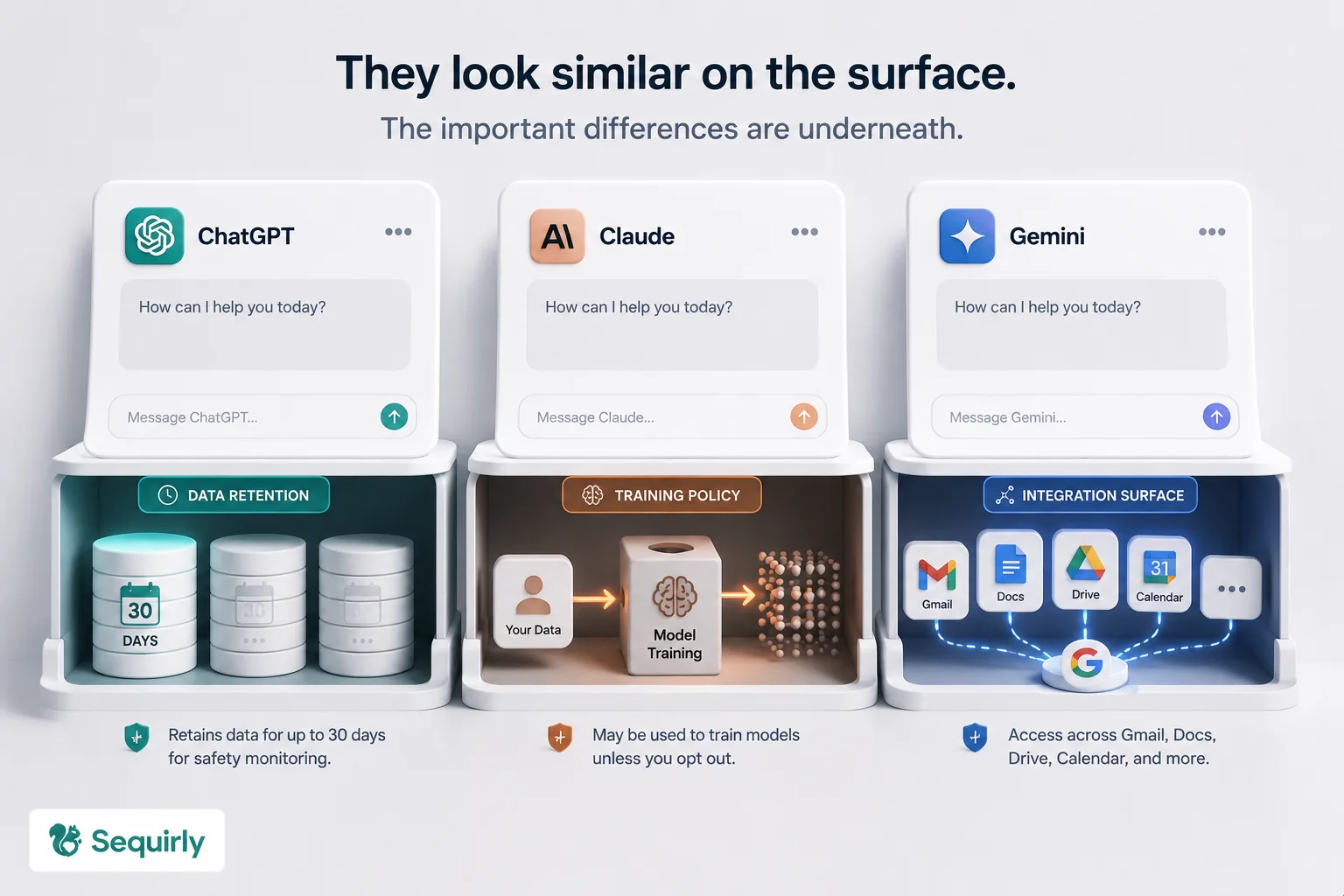
Every comparison post you'll find ranks these three on features, speed, and price. Almost none of them compare what actually matters if you handle sensitive data: what happens to the things you type.
Here's what the privacy pages don't make obvious, and what you should actually do about it.
The Four Things That Actually Matter
Most AI safety comparisons list certifications and compliance badges. That's not what protects your team on a Tuesday afternoon when someone pastes a client spreadsheet into a chat window.
Here's what actually matters:
Does it train on your data by default?
If yes, anything your team types could influence future outputs for other users. That's the biggest risk.
How long does it keep your data?
Even if a tool doesn't train on your data, it might store your conversations for weeks or months. Stored data is attackable data.
What's the security track record?
Every tool has had incidents. The question is how bad, how recent, and how they responded.
What changes when you pay?
Free and paid tiers have very different data policies. This is where most teams get caught.
ChatGPT: The Most Used, the Least Private by Default
ChatGPT has over 900 million weekly active users. So your team is most likely using it. It's also the one with the weakest default privacy settings.
Default training policy:
On the free tier, OpenAI uses your conversations to train future models. This is on by default.
You have to manually go to Settings > Data Controls and toggle off "Improve the model for everyone." Most people never do this.
On ChatGPT Team and Enterprise, training is off by default.
But if even one team member is using a personal free account on the side, that protection disappears for their conversations.
Data retention:
Even after you opt out of training, OpenAI retains your data for 30 days for safety monitoring.
Security track record:
This is where it gets rough.
In 2025, over 4,500 private ChatGPT conversations were indexed by Google because of a "Make this chat discoverable" feature that users didn't fully understand. Business strategies, personal confessions, and internal discussions were suddenly publicly searchable.
Researchers found multiple vulnerabilities in GPT-4o and GPT-5 that allowed attackers to steal data from users' memories and chat histories.
And 225,000+ ChatGPT credentials ended up on the dark web, stolen by infostealer malware.
OpenAI also confirmed a data breach through their analytics partner Mixpanel in November 2025, exposing limited customer information.
Claude: The Privacy-First Reputation That Got Complicated
Anthropic built Claude's brand on being the "safety-focused" AI company. For a long time, that reputation was deserved. Claude was the only major AI tool that didn't train on user data by default.
Then September 2025 happened.
Default training policy:
Anthropic changed its consumer terms so that Claude now trains on user conversations by default, unless you opt out. If you didn't respond to the policy update by September 28, 2025, your settings defaulted to consent.
This caught a lot of people off guard. Teams that chose Claude specifically for its privacy stance may not realize the rules changed.
To opt out: go to Privacy Settings and turn off "Help improve Claude."
Data retention:
- If you opt out of training, Anthropic retains your data for 30 days.
- If you opt in, they can retain it for up to five years. That's a significant difference based on a single toggle.
Security track record:
Claude has had fewer direct data breaches than ChatGPT, but it's not clean.
Claude Code vulnerabilities were discovered that could have allowed attackers to silently gain control of a developer's computer.
And in the Mexican government breach, an attacker jailbroke Claude to write exploit scripts that stole 150GB of government data, including 195 million taxpayer records.
On the positive side, Anthropic detected and disrupted an AI-powered espionage campaign in September 2025, showing they actively monitor for misuse.

Prevent accidental data leaks to ChatGPT, Claude, and Gemini.
Sequirly scans your prompts and uploaded files before they're sent. If it finds credentials, client records, or API keys, it stops you before the request goes out.
Gemini: The One Tied to Everything Else You Do
Gemini is different from ChatGPT and Claude because it's not a standalone tool. It's woven into Gmail, Docs, Drive, Calendar, and the entire Google ecosystem your team probably already uses.
That means Gemini can see your email, your calendar, your documents, and your Drive. Useful, yes.
But when something goes wrong, it goes wrong everywhere at once.
Default training policy:
For Google Workspace users (Business, Enterprise), Gemini does not use your data to train models. This is a clear policy and it's solid.
For consumer Gemini (the free app), Google can use your conversations for model improvement.
You can opt out by turning off "Gemini Apps Activity" in your Google account settings, but the default is on.
Data retention:
Consumer Gemini conversations are set to auto-delete after 18 months by default. You can shorten this, but 18 months is a long time for sensitive conversations to sit in Google's servers.
And, workspace conversations follow your organization's existing Google data retention policies.
Security track record:
Gemini hasn't had a major credential leak like ChatGPT. But the vulnerabilities it has had are scarier in a different way, because they can reach into your entire Google account.
The GeminiJack vulnerability discovered in late 2025 showed that an attacker could exfiltrate corporate data through something as simple as a shared Google Doc or calendar invitation. Because Gemini has access to your email, calendar, and documents, a single vulnerability becomes a gateway to everything.
Researchers also found the "Gemini Trifecta", three separate vulnerabilities in Gemini's Cloud Assist, Search Personalization, and Browsing Tool that exposed millions of users to silent data theft.
Side-by-Side Comparison
| Criteria | ChatGPT | Claude | Gemini |
|---|---|---|---|
| Free tier trains on data? | Yes (default on) | Yes, since Sept 2025 (default on) | Yes (default on) |
| How to opt out | Settings > Data Controls | Privacy Settings > Help improve Claude | Google Account > Gemini Apps Activity |
| Paid tier trains on data? | No (Team/Enterprise) | No (Team/Enterprise/API) | No (Workspace) |
| Data retention (opted out) | 30 days | 30 days | Up to 18 months (adjustable) |
| Data retention (opted in) | Not specified | Up to 5 years | 18 months (default) |
| Major 2025 incidents | Private chats indexed by Google, Mixpanel breach, 225K credentials leaked | Policy change backlash, Claude Code vulnerabilities, used in Mexico govt hack | GeminiJack zero-click vulnerability, Gemini Trifecta (3 flaws) |
| Paid plan cost | $25/user/mo (Team) | $25/user/mo (Team) | $14/user/mo (Workspace Business) |
So Which One Should Your Team Use?
Here's the honest answer: on their free tiers, none of them are safe for work involving sensitive data. All three now train on your conversations by default.
On paid tiers, all three are reasonable, with the right settings.
If you forced me to rank them for a team handling sensitive data:
Claude Team has the smallest data collection scope and the strongest stated commitment to safety, though the September 2025 policy shift hurt that trust. If your team verifies their settings, it's still the strongest option on paper.
Google Workspace with Gemini is the most practical if your team already lives in Google. The privacy policy is clear and the paid tier doesn't train. But the integration surface area means a single vulnerability has wider blast radius.
ChatGPT Team is the most popular and the most battle-tested, but also the one with the most public incidents. If your team is going to use it regardless (and they probably are), lock down the settings immediately.
But here's what matters more than which tool you pick: how you configure it.
A team on Claude Free with default settings is less safe than a team on ChatGPT Team with everything locked down. The tool matters less than the setup.
If you haven't already, read our complete AI security guide for teams for the full setup playbook.
And if you want a safety net that works across all three tools, give Sequirly a try. It catches sensitive data before it's sent to any AI tool, regardless of which one your team uses. Takes about 2 minutes to set up.