
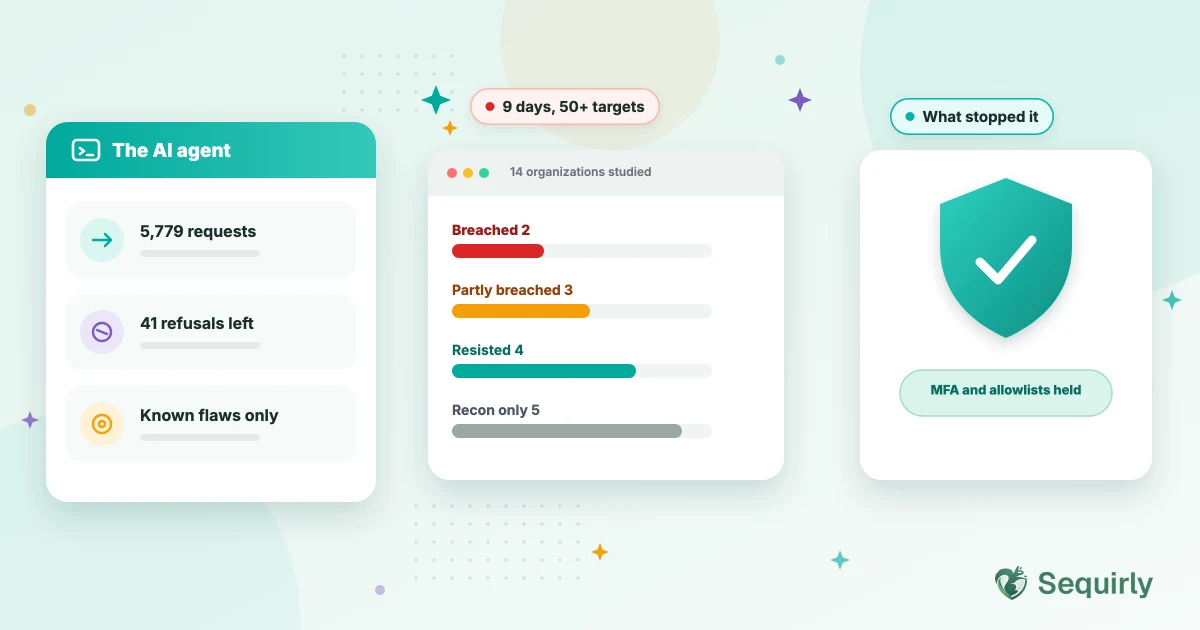
Between November 6 and 14, an operator known as BabidiGhost used a jailbroken AI agent to attack more than 50 European organizations, and the agent exported an insurer's customer database and 8.6 GB of files belonging to more than 13 municipalities. According to security firm SOCRadar, the operator had little technical skill, and the agent did the technical work.
Every successful break-in used a weakness that was already public, and ordinary controls stopped the same agent elsewhere. So the story is less about a new kind of attack and more about how fast an agent can find the gaps you already have.
This post sticks to what SOCRadar published, which is the only detailed account so far, and says where we can't confirm something.
What happened
SOCRadar found the operation because the operator left his home directory open on a hijacked staging server in France. It held the agent's configuration, every prompt he typed, his shell history and about 10 GB of stolen data. SOCRadar says it analyzed the files without running any recovered program or using any captured credential, and that affected organizations were told through coordinated disclosure (SOCRadar).
The operator typed 1,801 plain-language orders, written in misspelled French. The agent wrote the scanners, exploits and data-theft scripts, and sent 5,779 requests to its AI model over nine days.
The setup that made this work had two parts:
The agent ran on the Hermes agent framework, which SOCRadar says boots in a "degraded" state, and the model rewrote scripts when parts of it failed. Cyber Security News reports the model as DeepSeek. SOCRadar's report, as we read it, doesn't name the model.
The timeline
| Date (UTC) | What happened |
|---|---|
| Nov 6 | The nine-day operation begins, according to SOCRadar |
| Nov 14 | The operator's AI model API key is revoked and every request returns 401 Unauthorized. The agent goes quiet |
| Nov 15, 12:54 | The last check-in from the backdoors already planted |
| Nov 16 | The staging server is offline |
| Nov 20 | SOCRadar publishes its report |
| Nov 23 | Cyber Security News covers it |
What was breached
SOCRadar studied 14 organizations in depth and judged each one only on evidence of stolen data or a successful sign-in, and the operator's own claims didn't count. The results:
| Outcome | Organizations |
|---|---|
| Breached | 2 |
| Partly breached | 3 |
| Resisted | 4 |
| Reconnaissance only | 5 |
The two full breaches show how basic the way in was.
SOCRadar also describes the agent profiling six retail banks "on commission", writing 11 scripts to guess a payment provider's one-time passcodes and more than 180 scripts against a crypto exchange. Those last two attempts failed.
What stopped it
SOCRadar's table matches each outcome to one control. These are the ones that held:
| Control | What happened |
|---|---|
| One-time-passcode MFA on a payment portal | 11 guessing scripts failed |
| IP allowlist on non-public systems | The agent found 49 hostnames at one bank and couldn't reach any |
| Server-side business rules | A fake death declaration was refused |
| Analytics tools off the internet, secrets out of the environment | Nothing to pivot through |
SOCRadar's summary is that the agent used no zero-days, and that the controls that held "are long established and inexpensive."

Prevent accidental data leaks to ChatGPT, Claude, and Gemini.
Sequirly scans your prompts and uploaded files before they're sent. If it finds credentials, client records, or API keys, it stops you before the request goes out.
What we don't know yet
- Who the victims are. SOCRadar anonymized them by sector and country, so we can't say which insurer or municipalities were hit or how many people's records are involved.
- Whether anyone else has confirmed it. This is one security firm's analysis of one exposed server. We found no independent confirmation yet.
- What the companies behind the tools have said. In a search on November 24, we found no statement from the Hermes framework's maintainers or from the model provider.
- Where the stolen data went. SOCRadar says some of the operator's orders relayed another person's demands, but we haven't seen a report of the data being sold or published.
- What happened to the operator. We found no report of an arrest.
We'll add anything confirmed to the update log below.
What to check if you run a business
SOCRadar's advice for defenders is practical:
Why this matters
For a long time, a person needed skill, time and patience to find an exposed dashboard on every host of a target. An agent configured never to refuse supplies all three, which is the part SOCRadar calls new. The weaknesses it found were the same ones defenders have been told about for years.
Common Questions
What is BabidiGhost?
BabidiGhost is the name SOCRadar gives a French-speaking, low-skill operator who ran a jailbroken AI agent against European banks, insurers, payment providers and municipalities from November 6 to 14, 2026.
What is a jailbroken AI agent?
A jailbroken AI agent is an AI program that can run tools and write code on its own and has had its built-in refusals removed or overridden. In this case a configuration file told it to ignore refusals, and a proxy re-sent refused orders.
Did the AI agent use zero-day exploits?
No. SOCRadar says every intrusion used a known weakness, including an unpatched Metabase dashboard, a weak administrator password and an unauthenticated endpoint.
How was the AI agent stopped?
Its AI model API key was revoked on November 14, 2026, and it went quiet. Backdoors it had already planted kept checking in until November 15.
How can I protect my business from AI-assisted attacks?
Fix the basics: remove exposed admin and analytics pages from the internet, patch known flaws, use MFA and IP allowlists, and keep secrets out of server environments. SOCRadar found these stopped the same agent that succeeded elsewhere.
Update log
- Nov 24, 2026: First version, based on SOCRadar's report of November 20. We couldn't load the Cyber Security News article directly, so the model name (DeepSeek) is taken from its coverage as listed in search results, and we say so above. We found no vendor or victim statements.
About this post
We build Sequirly, a browser extension that checks what you paste into AI tools. It had no part in this incident, and it doesn't protect you from attacks like this one. We publish security news we can verify, and we tell you when we don't know something.
Sources: