
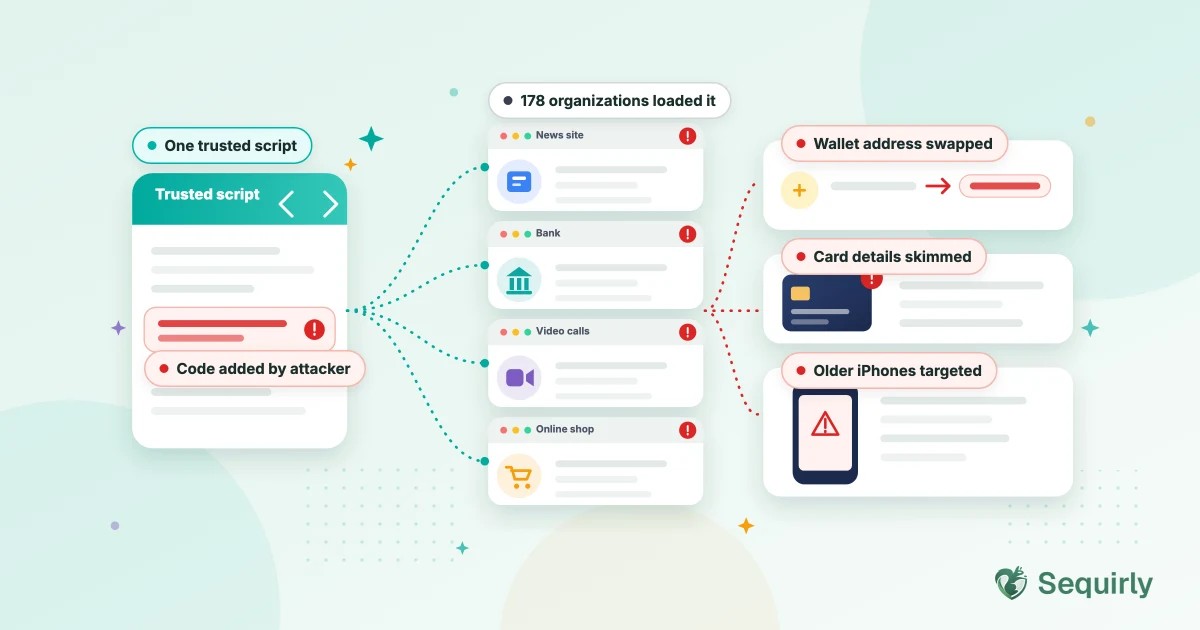
On Monday, November 16, an attacker used a flaw at Optimizely, a company that helps websites test different versions of their pages, to put malicious code on the websites of at least 178 organizations. They include the BBC, CNN, Zoom, Salesforce, HSBC and IKEA.
These sites load a script from Optimizely's servers, and the attacker changed what that script contained. So anyone who opened an affected page that day could have received code built to swap crypto wallet addresses, skim card details and attack older iPhones.
Nothing published so far says the sites' own servers were breached, and Optimizely says it has fixed the flaw and removed the code. What you need to check depends on what you did on those sites, so let's start with how a testing tool ended up delivering malware.
What happened
Optimizely sells software that lets companies test changes to their websites, such as a different headline or button. A company that uses it adds one line to its pages, and that line loads a script from Optimizely's servers every time someone visits.
Each company's script has a field called Project JavaScript, where customers can add their own code. The attacker wrote malicious code into that field for many customers at once. Security firm Report URI found the code in 188 of the 1,611 Optimizely scripts it checked, spread across 178 organizations.
The file still came from Optimizely's servers with Optimizely's security certificate, so browsers treated it as safe. Scott Helme of Report URI summed it up this way: "trusted JavaScript doesn't always remain trustworthy."
Optimizely says an unauthorized party exploited a vulnerability in the account sign-up flow of its Experimentation product to add the code, according to BleepingComputer. It hasn't explained how that flaw gave the attacker access to unrelated customers' projects.
It also says it fixed the flaw, removed the code, ended active sessions, revoked tokens and told affected customers, according to its incident notice and its statement to BleepingComputer. Report URI confirmed that every infected file was clean by 23:11 UTC on November 16.
The timeline
All times are UTC, and Eastern Time is five hours behind.
| Time (UTC) | What happened |
|---|---|
| Nov 16, 04:21 | First infected script seen, on the BBC's Optimizely file (11:21 p.m. Eastern on Sunday, Nov 15) |
| Nov 16, 08:28 | Code that swaps crypto wallet addresses first seen on bbc.com |
| Nov 16, 13:43 | Card-skimming code added |
| Nov 16, 17:13 to 17:57 | Code that attacks iPhones and iPads running iOS 18.6 or older added |
| Nov 16, about 20:40 to 21:10 | Clean-up begins, including Ledger, Smartsheet and the BBC |
| Nov 16, 21:52 | One infected file left, at TalkTalk |
| Nov 16, 23:11 | Report URI confirms every infected file is clean |
| Nov 17, 01:02 | Optimizely posts its incident notice |
The times come from Report URI and Optimizely. The attacker rebuilt the code 26 times that day, so what visitors received changed through the day.
What the malicious code did
Researchers found four things in the code.
Some things were out of its reach. Card fields inside a payment provider's own hosted frame, such as Stripe or Adyen, couldn't be read, and neither could cookies marked HttpOnly. StepSecurity's analysis also found that the skimmer didn't collect the cardholder's name or billing address.
Who was affected
Report URI says the real number is probably higher than 178. The biggest groups were 32 banks and financial firms, 23 technology companies, 20 retailers, 12 streaming services and 10 news organizations. Named victims include:
- News: BBC, CNN, Fox News and NPR
- Technology: Zoom, Salesforce and GitLab
- Banking and finance: HSBC in several countries, Equifax and ABN AMRO
- Retail and travel: IKEA, ASOS and Air France-KLM
- Telecoms and streaming: TalkTalk, Virgin Media and Peacock
- Crypto: Ledger
Newsweek published the full list of 178. Being on it means researchers found the code in that organization's Optimizely script, and how many visitors actually lost data is unknown.
Salesforce says it disabled Optimizely scripts across its preview and production sites as a precaution and is investigating. As of November 17, we found no public statement from the BBC or CNN.

Prevent accidental data leaks to ChatGPT, Claude, and Gemini.
Sequirly scans your prompts and uploaded files before they're sent. If it finds credentials, client records, or API keys, it stops you before the request goes out.
What we don't know yet
If you visited an affected site on November 16
Don't panic. What you need to check depends on what you did on the site, and each check takes a few minutes.
Report URI's analysis doesn't list password theft among what the code did. Still, if you were signed in to a service while you copied a wallet address on an affected page, watch that account for login alerts you don't recognize.
If your website uses Optimizely
These steps come from Report URI and StepSecurity, and they're worth doing today.
How to limit the damage from any third-party script
Any site that uses outside scripts can end up in this position, so these steps apply well beyond Optimizely.
Why this keeps happening
A site can be compromised through a third-party supplier without its own code or servers ever being breached, and a script that was safe yesterday can change overnight. In October we covered a similar attack on AI developers, where a poisoned release of a popular library stole cloud and AI provider keys. Here's how to check if your keys were exposed.
Common Questions
Was the BBC hacked?
Researchers found the attacker's code in the BBC's Optimizely script on November 16, so visitors to bbc.com received it. Nothing published so far says the BBC's own servers were breached, and we found no BBC statement as of November 17.
What is Optimizely?
Optimizely is a company whose software lets websites test different versions of their pages. Sites that use it load a script from Optimizely's servers on every visit.
Is it safe to visit these sites now?
Optimizely says it fixed the flaw and removed the code, and Report URI confirmed that every infected file was clean by 23:11 UTC on November 16. Keep your phone and computer updated as usual.
Was my card stolen if I visited one of these sites?
Only if you typed card details into a site's own payment form while the skimmer was running, which was from about 13:43 UTC until the clean-up that evening. Cards entered in a payment provider's hosted form couldn't be read, and nobody knows how many cards were taken.
What is a supply chain attack?
A supply chain attack is when criminals compromise a supplier that many organizations rely on, so the harm reaches all of its customers at once.
Do I need to change my passwords?
Report URI's analysis doesn't list password theft as part of this attack. Watch the accounts you were signed in to for login alerts you don't recognize, and change the password on any account that shows unusual activity.
How many websites were affected?
At least 178 organizations. Report URI found the code in 188 of the 1,611 Optimizely scripts it checked and says the real number is probably higher.
About this post
We build Sequirly, a browser extension that checks what you paste into AI tools. It had no part in this incident, and it doesn't protect you from malicious scripts on other websites. Here's how to check what any extension does with your data. We publish security news we can verify, and we tell you when we don't know something.
Sources:
- World's largest brands infected with malware via Optimizely: Scott Helme, Report URI
- Web Experimentation security incident: Optimizely status page
- Optimizely hack infected CNN, Fox News, BBC, Salesforce sites with malware: BleepingComputer
- OPTIMJACK: Optimizely-hosted scripts loaded a crypto clipper and card skimmer on 178 organizations: StepSecurity
- Optimizely hack turns world's biggest websites into malware dispensers: The Register
- Malware spread through Optimizely hits 178 organizations: Help Net Security
- Cyber attack hits 178 major websites: full list of organizations: Newsweek