
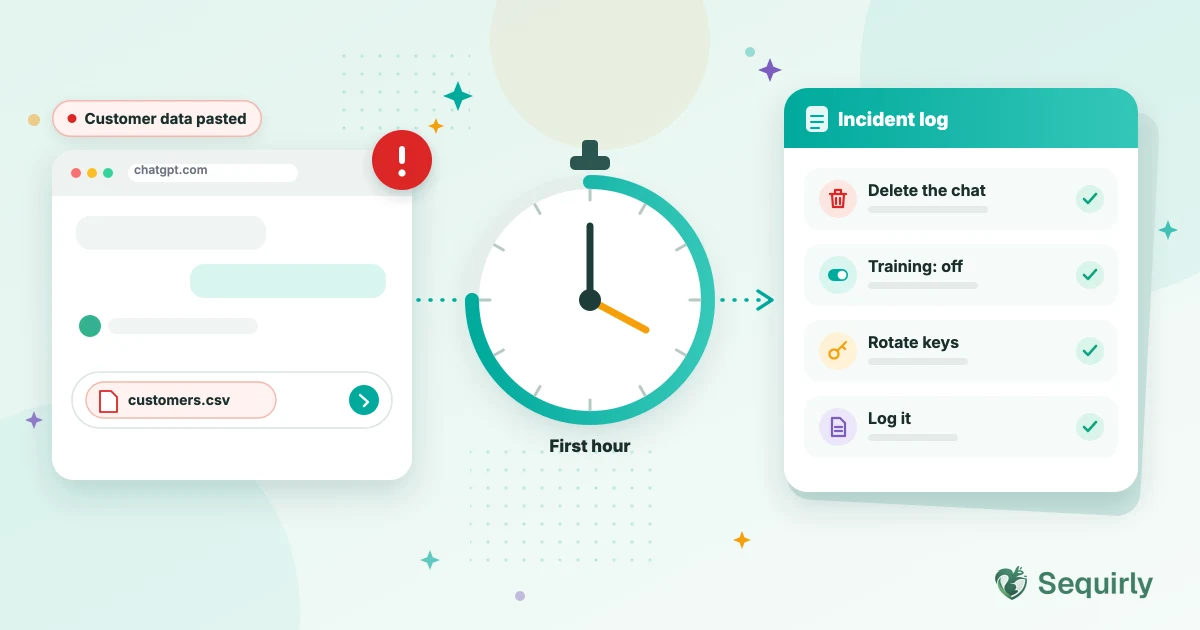
If an employee pasted customer data into an AI tool, the first hour is for facts. Find out which account it went into, what exactly was pasted and whether training was on, then decide within 24 hours whether you have to tell anyone.
Those three facts decide how serious this is. A paste into a company account with training off is a very different problem from a paste into a free personal account with training on.
Honestly, I'd rather you hear about it from your employee than from a customer. So the first thing to protect is the next report. If this one ends in a telling-off, the next person will stay quiet.
Let's start with the three questions that tell you what you're dealing with.
Start with three questions
| Question | Why it matters | Where to look |
|---|---|---|
| Which account was it? | Company accounts on a business plan come with contract terms. Personal accounts don't. | Ask the employee, then check your workspace's member list |
| What exactly was pasted? | Names and emails are one level of risk. Payment details, health data and credentials are another. | Ask for the chat link or a screenshot |
| Was training on? | If it was, the text may be used to train the model. | ChatGPT: Settings, Data controls. Claude: Settings, Privacy |
One practical tip: don't ask the employee to paste the data again to show you. The chat link or a screenshot of the conversation is enough.
The first hour
The first day: do you have to tell anyone?
This is the part everyone worries about, so let's take it in order.
Is personal data involved? The GDPR defines a personal data breach to include unauthorised disclosure of personal data. Whether a paste counts depends on the facts, mostly which account it went into and what your contract with the provider says. If you aren't sure, treat it as a possible breach until a lawyer tells you otherwise.
Does a deadline apply? If the GDPR covers you, the 72 hours in the box above is the deadline for telling the regulator. The same law says you must also tell the people affected when the breach is likely to put them at high risk, with exceptions such as data that was encrypted. In the US, the rules depend on the state and the industry.
What do your contracts say? Your customer agreements may set their own notice period, so read the notice clause before you decide.
Have you written it down? The GDPR asks you to record every breach, including the ones you decide not to report. A short log protects you if anyone asks later.
Here's a rough way to sort it.
| What happened | Usual next step |
|---|---|
| Company account, training off, low-sensitivity data | Document it, fix the cause and move on |
| Company account, customer personal data | Document it, check your contract and ask a lawyer whether you need to notify |
| Personal account or training on, customer personal data | Treat it as a possible breach, call a lawyer and expect to tell the customer |
| Payment, health or government ID data, or credentials | Treat it as serious in every case, and rotate credentials first |
This isn't legal advice, and the rules vary by country and industry. It's a starting point for the conversation with your lawyer.

Prevent accidental data leaks to ChatGPT, Claude, and Gemini.
Sequirly scans your prompts and uploaded files before they're sent. If it finds credentials, client records, or API keys, it stops you before the request goes out.
The first week
If you do have to tell a customer, keep the message plain and short.
We found out on [date] that one of our team members entered [type of data] into [tool and account type] on [date]. We deleted the conversation on [date] and turned off the setting that allows model training. The data involved was [description]. We recommend [what the customer should do, if anything]. You can reach [name] at [contact] with questions.
Then fix the cause, because the same paste will happen again if nothing changes.
What to put in your incident log
Keep one row per incident. A shared spreadsheet is enough.
| Field | What to write |
|---|---|
| Date and time | When it happened and when you found out |
| Reported by | Who told you, and how |
| Tool and account | For example, ChatGPT Free, personal account |
| Data involved | The type of data and roughly how many people it covers |
| Training setting | On or off when it happened |
| Actions taken | Chat deleted, training turned off, credentials rotated |
| Who was told | Customers, regulator, insurer, with dates |
| Owner of the follow-up | One name, and a date |
Where Sequirly fits
A response plan limits the damage after a paste. Sequirly checks what you're about to send to ChatGPT, Claude or Gemini and warns you before sensitive data leaves your browser. The admin sees which category of data was flagged and which tool was involved, and never the content of the prompt.
If you want rules built around the customer data you handle, the Sequirly team will sit down with you, understand your requirements and build the setup around your workflow.
Sequirly has limits too. It works in the browser, so it doesn't cover desktop AI apps, and it doesn't replace a response plan.
Common Questions
What should I do if an employee pasted customer data into ChatGPT?
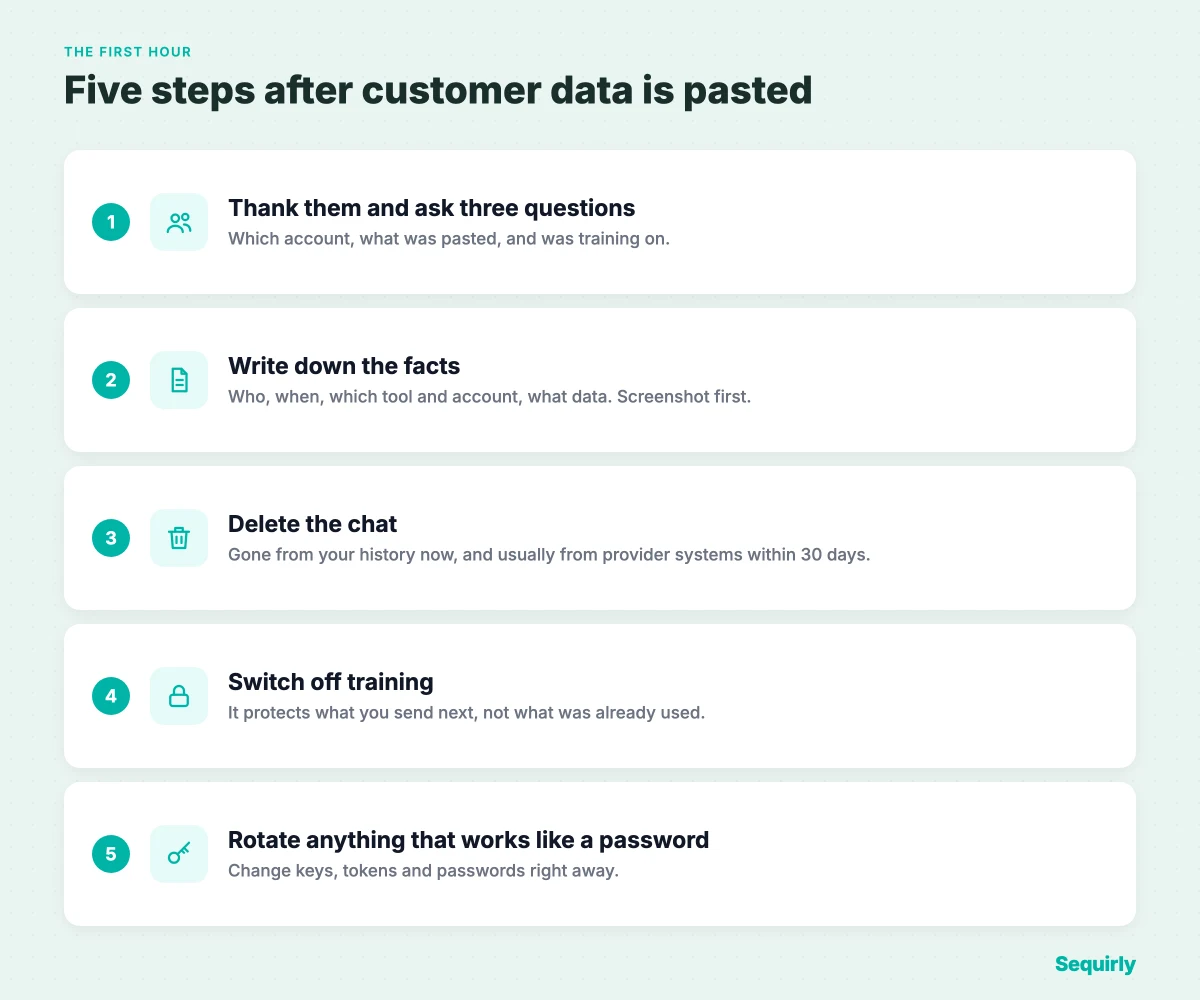
Find out which account it went into, what was pasted and whether training was on. Then delete the chat, turn off training, rotate any credentials and decide within 24 hours whether you have to notify anyone.
Do I have to report an employee pasting customer data into an AI tool?
It depends on the law that applies to you, the type of data and your customer contracts. Under the GDPR, a personal data breach has to be reported to the regulator within 72 hours where feasible, unless it's unlikely to put people at risk. Ask a lawyer if you aren't sure.
Can OpenAI or Anthropic delete what an employee pasted?
Deleting the chat removes it from the history immediately, and both companies say deleted chats are removed from their systems within 30 days, with some exceptions. Neither can take back data that was already used for training.
Is pasting customer data into ChatGPT a GDPR breach?
It can be. The GDPR defines a personal data breach to include unauthorised disclosure of personal data. Whether a paste counts depends on the account it went into and your contract with the provider.
Should I discipline the employee?
A single honest mistake rarely calls for it. The bigger risk is that people hide the next one, so reward the report and fix the process.
Where to start
Write down the three answers for this incident, then log it. After that, generate a policy so the next person knows the rule.
Then try Sequirly free so the paste gets checked before it's sent. Or if you'd like to talk it through first, book a quick demo.