
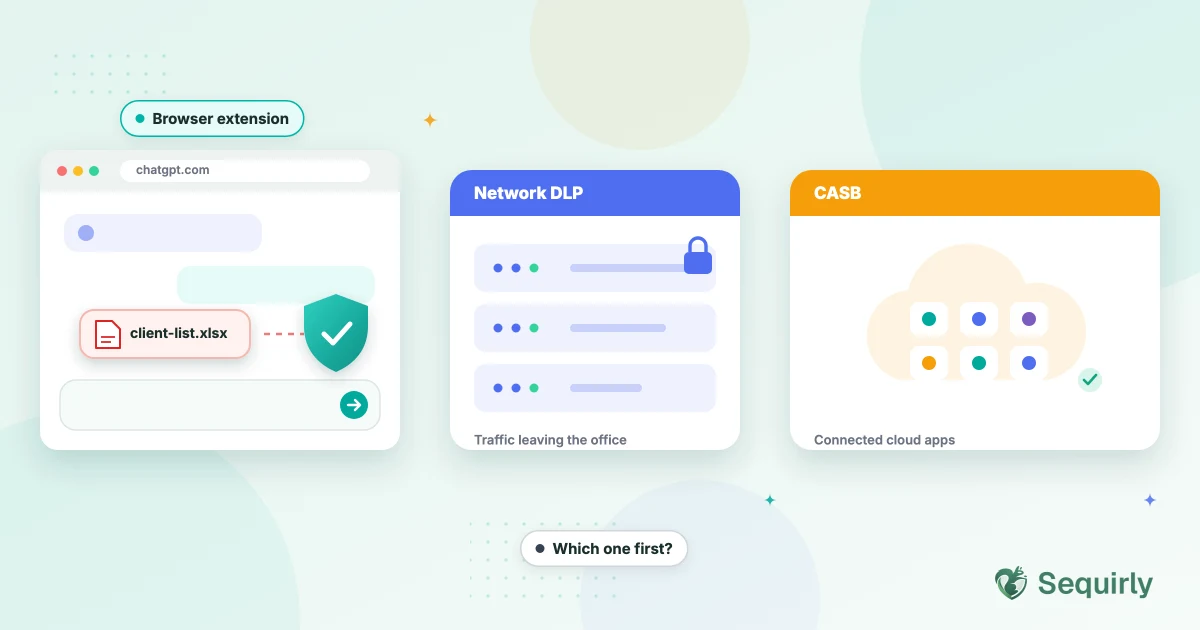
A 20-person team usually needs a browser-based check first, because that's where people paste data into AI tools. Network DLP and a CASB cover other things, and they're worth adding when you have an IT team, compliance duties or a lot of company-managed software.
These three get mixed up all the time, and the mix-up is how teams end up believing they're covered when they aren't. Each one sees a different part of the journey a piece of data takes, so let's go through them.
We build Sequirly, a browser extension, so we've said where the other two win. Check our claims against your own setup.
What each one is
- Browser extension DLP runs inside the browser and sees what you type, paste or upload into a web page before it's sent.
- Network DLP inspects traffic as it leaves your office or device, usually through a gateway or proxy. To read encrypted web traffic, it generally has to decrypt it first.
- A CASB (cloud access security broker) sits between your people and the cloud apps they use. It enforces rules on the apps you've connected, such as which accounts can sign in and what files can be shared.
What each one sees
| Browser extension | Network DLP | CASB | |
|---|---|---|---|
| Sees the paste before it's sent | Yes, in the browser | No, it sees traffic as it leaves | No |
| Sees personal accounts on AI sites | Yes, in the browser | Hard, because company and personal accounts use the same site | Usually only for apps you've connected |
| Sees desktop and terminal AI tools | No | Yes, if the traffic goes through it | Only if connected |
| Sees files already stored in cloud apps | No | No | Yes, for connected apps |
| Needs IT to run it | Rarely | Yes | Yes |
| Setup time | Minutes | Weeks | Weeks |
The pattern is that each tool is strong where it sits and blind elsewhere. Vendors write their own versions of this table, so ask any of them to demonstrate the AI case on your own accounts.
Where each one wins
Browser DLP wins when the question is "what did this person just paste?" It works on personal and company accounts alike and needs no IT project. It only covers the browser, which is its main limit.
Network DLP and a CASB each win in cases a browser tool can't touch.
Both also take real work to run. A 20-person team without an IT person often can't carry that load.

Prevent accidental data leaks to ChatGPT, Claude, and Gemini.
Sequirly scans your prompts and uploaded files before they're sent. If it finds credentials, client records, or API keys, it stops you before the request goes out.
Which one fits your team
| Your situation | Start with |
|---|---|
| 20 people, no IT team, mostly browser-based AI use | A browser check, plus your AI plan's data settings |
| You already run a network gateway or SASE service | Add a browser check for the paste, and use the gateway for other apps |
| Customer files live in connected cloud apps and you worry about sharing | A CASB or the sharing controls in your cloud suite |
| Compliance requires central logging across tools | A layered setup with network and CASB controls, with a browser check at the paste |
For most small teams the first row applies. You can add the others later, because the layers don't conflict.
Where Sequirly fits, and where it doesn't
Sequirly checks what you're about to send to ChatGPT, Claude, Gemini and Perplexity and warns you before sensitive data goes. It works on personal and company accounts, and takes about two minutes to install. Admins see which category of data was flagged and which tool was involved, and never the content of the prompt.
It works in the browser only, so it doesn't cover desktop apps or terminal tools, and it doesn't replace a CASB or network DLP if you need them. If you want rules built around the data your team handles, the Sequirly team will sit down with you, understand your requirements and build the setup around your workflow.
For a longer comparison, see Sequirly vs enterprise DLP and DLP for ChatGPT, Claude and Gemini.
Common Questions
What's the difference between browser DLP, network DLP and a CASB?
Browser DLP checks what you type or paste into a web page before it's sent. Network DLP inspects traffic leaving your network or device, and a CASB enforces rules on the cloud apps you've connected.
Does a CASB stop employees pasting data into ChatGPT?
A CASB controls access to connected cloud apps and what's shared through them, but it generally doesn't check text pasted into a chat box. Ask your vendor to show you the AI case on a personal account.
Does network DLP work on ChatGPT?
It can, if encrypted traffic is decrypted at your gateway and the traffic goes through it. Telling a personal account from a company account on the same site is the hard part.
Does a small team need a CASB?
Not usually. A CASB pays off when you have many managed cloud apps and someone to run it, so small teams often start with a browser check and add more later.
Can you use browser DLP and network DLP together?
Yes. The browser check covers the paste, the network layer covers other apps, and they don't interfere with each other.
Where to start
Find out what's already been shared. Scan your ChatGPT history, or ask your team to scan theirs. It runs in your browser, and nothing is uploaded.
Then Try Sequirly Now so the paste gets checked on every account. Or if you'd like to talk it through first, book a quick demo.